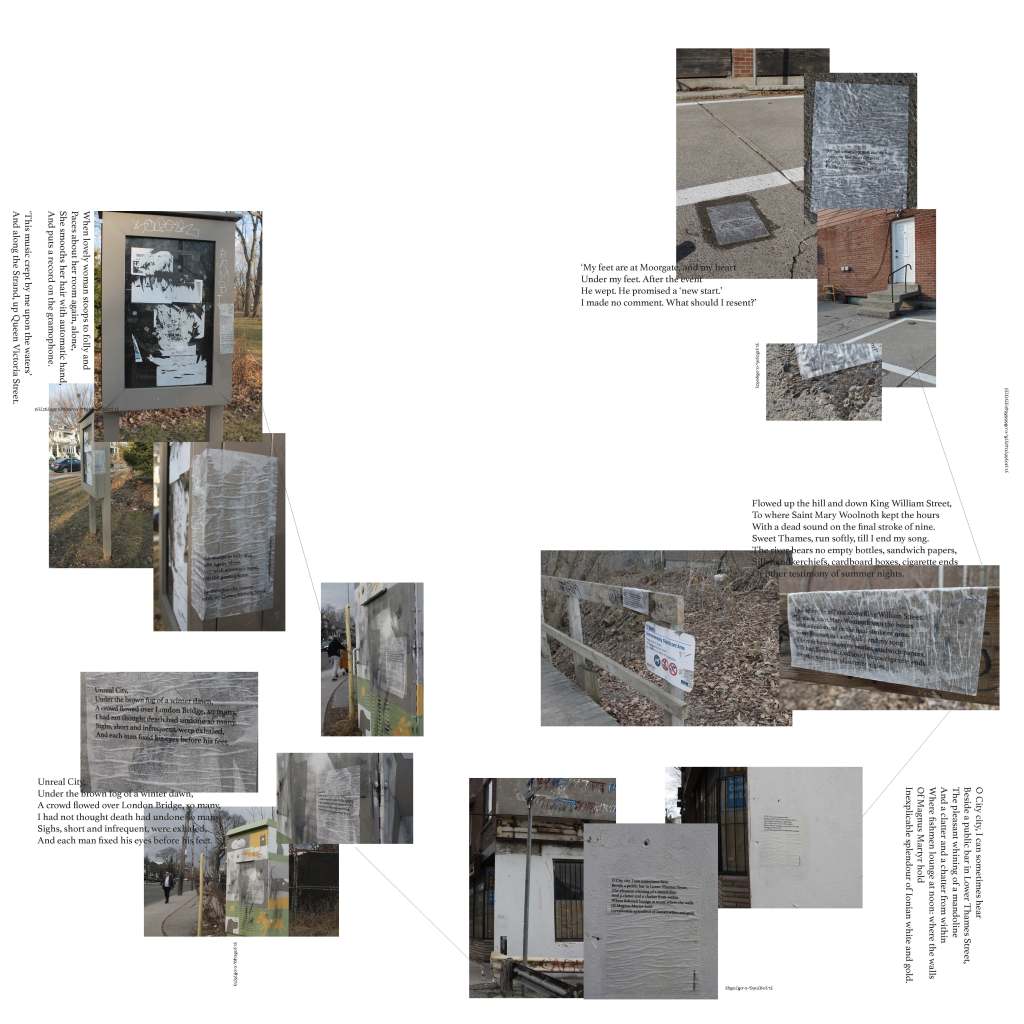
Wastelands of one’s own (2024) was brought into reality through the superimposition of London, England over a map of Toronto at equal ratio, the location of each intervention’s coordinates with a different location discussed in Ts. Eliot’s The Waste Land. This Canonical work originally published just over one hundred years ago in England, plays on the dejection of community in London following the first world war and the societal transformation which occurred during the interwar period. Under the context of present-day Toronto, the writings’ of T.S. Eliot takes on new meanings. In the “after-math” of Canada being under British Rule, a spectre of British culture continuously lingers, from street names to Governmental and economic systems, their foundation of “Canada” remains ever present.
Eliot’s The Waste Land (1922) is known for its repetitive format, and it’s strange habit of lying between order and disorder, his use of repetitive phrases creates a continues illusion that what comes before, will always return, creating a sort of “eternal presence” in the reader. Despite his many references to place, there is no formal logic to each reference be it the sea, the desert, or Lower Thames Street. In this way, The Waste Land is malleable and remains contemporary to any context. Mathew Scully quotes Catherine Malabou’s Plasticity at the Dusk of Writing, stating “the reading that seeks to reveal the form left in the text through the withdrawing of presence, that is, through its own deconstruction” proposing that her idea of ‘Plastic Reading’ bodes towards the poems experimental disorder and transformation of language.
 Ella Spitzer Stephan