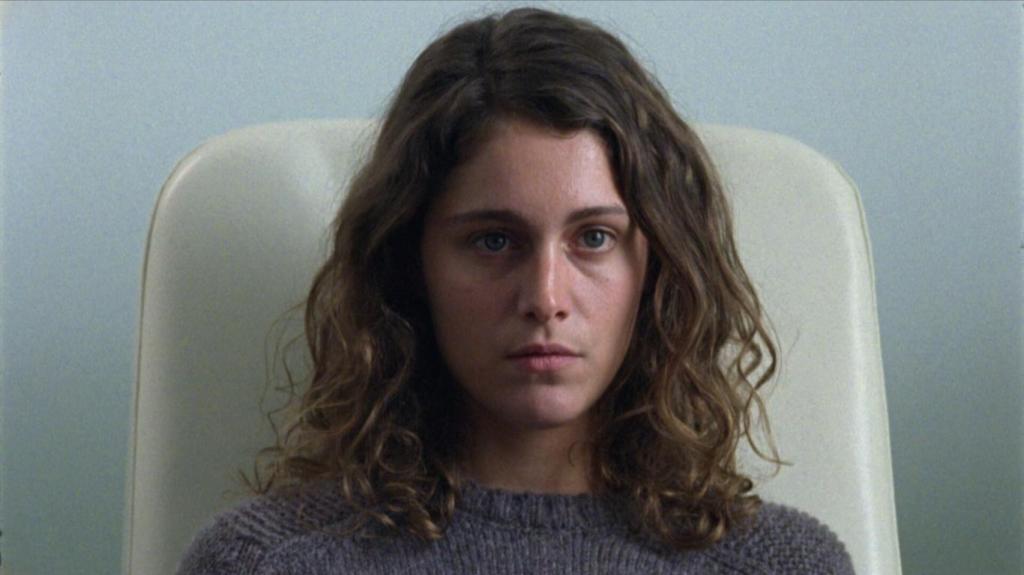
Attenberg (2010) directed by Athina Rachel Tsangari, takes set an industrial seaside town in Greece called Aspra Spitia, a community planned in the 1960s to house aluminum factory workers. [1] For this reason, many of the interior as well as exterior shots exist to depict the conflict between the natural environment and industrial, unhomely places where the characters dwell.
Athina Rachel Tsangari is a Contemporary Greek filmmaker commonly known in connection to the “Greek Weird Wave” film movement. Holding three degrees, one in philosophy, one in performance and one in film directing, her work adapts a critical approach which analysis how body language, and movement communicates ideas of the precarity of human existence and the interdependent nature of all life, human and not. In Attenberg (2010) under the context of the economic collapse of Greece in the early 2000s, she envisions a non- anthropocentric future through an analysis of human mortality being something which calls human governance and social constructs into question. As described by Maurice Blanchot in The Unavowable Community (1988), Humans are part of an earthly community, our mortality is what constitutes the true community between all beings, death is the “impossible communion”.[2] Attenberg draws attention to this through the incorporation of humans imitating non-human forms as a form of escapism. Judith Butler describes this reliance on one another as inherent to our social fabric, “Through our bodies we are implicated in thick and intense social processes of relatedness and interdependence; we are exposed, dismembered, given over to others, and undone by the norms that regulate desire, sexual alliance, kinship relations, and conditions of humanness.” (Pp.55)[3]
The sequence analyzed in this text takes place around a critical moment in the plot when Marina’s father, Spyros begins to reach the end of his life, and slowly loses his own agency leading to an increase in care by Marina and a further decrease in dialogue. The sequence opens with Marina carefully washing her father’s hair, Spyros’s head is perfectly framed, he says nothing but blinks and looks up towards Marina. The director’s specific choice to use minimal dialogue, pertains to this idea of existing in alternative forms of life, non-verbal communication playing a large roll in other species ways of interaction, which are emphasized throughout Attenberg. Despite the oftenest lack of speech, the communication brought upon by their facial expressions speaks volumes as a form of “universal understanding” which translates not only between people, but between various species as well.
Tsangari’s use of 35 mm colour film creates an aura of nostalgia, the use of an “outdated” medium makes the film feel as though it longs for another time period, a time one cannot return too. A perfect metaphor for Marinas contemplative state, as she transits from one location to the next coming to terms with the impending loss of her father. The film stock has a blue hue to it, a colour oftenest associated with melancholia and grief, exasperating the existential theme of grief in this film. Filmed with a deep focus lens, everything is equally in focus meaning there is never any hierarchy between the characters. Within this sequence the camera never pans, even when the subjects of the film becomes cropped out of frame. However, despite this staticity, the camera is susceptible to slight movement and bouncing dependent on the action in the shot, such as while Marina washes spyros’s hair. This connects to the sense of “realism” the director explores, the camera becomes one with the setting. Recalling a history of “slow cinema”, long, contemplative shots are favored over heavy dialogue and action. This contemplative method of film making has a long history and works in protest of the hyper productivity engrossed by capitalism, returning the viewer to the aesthetics of everyday actions.
As every shot in this sequence is a still shot, the viewer never gets the feeling they are following along with the action, but rather that they are peering through a window into a private setting. This feels most evident when Marina helps her father off the floor so he can look into the mirror after carefully washing his hair, but as they stand the camera is static, their faces leave the frame, leaving one peering at their legs and torsos. This heightens the sense of voyeurism in the film, it feels as though the viewers are forgotten or left behind. Psara’s explains this framing through Sarah Ahmeds reading of how bodies inhabit space, “as Ahmed explains, is the effect of inhabitance, as a dynamic extension of the body into space, which affects what comes within reach, what becomes familiar and what remains out of reach or excluded from our homing devices.” (pp. 129)[4] The viewer is only partially “let in on” their inhabitation of space, and therefore always feels like the unwelcomed other.
In the subsequent shot, the attention is immediately returned to Marina’s hands, we watch her cut off a leg of the aloe plant, all that sits in frame is the plant and the careful movements of her hands. This continues focus on the choreography of Marina’s hand movements brings attention to the role of hands in labor production.[5] Since one’s body is ones means of production; one’s hands play the primary role as “tool bearer” for the body. It is what carries out the labor work, as well as what one uses to navigate interpersonal relations. As she scrapes out the aloe, the sound of crashing waves coming from behind the camera recalls the sea and foreshadows her father’s final resting place. This careful framing of hand gestures returns later as she massages the aloe into her father’s hand, this careful application of a plants remnants to his hands is a marker for the approach of his death and return to the earth.
In the shot where Marina and Bella do their choreographed dance, they both wear matching dresses which vary only in colour, this contrast to the casual attire Marina wears in the other shots documenting day to day life. This choice of more formal attire creates a shift to a different layer in the film, one which exists outside of its linear narrative, and reads as a performance, or interlude to the film. In this shot the camera is static as they run directly into the white wall space of one of the Greek residential buildings at the end of the frame, they shake their hands behind themselves as if mimicking a bird. Marina and Stella’s violent slam against the wall is a metaphor for the final deterioration of her father’s health, it is the inevitable “crash” of life which Marina is being confronted by. These shots which interrupt the temporal narrative of the film show us Marinas internal reactions to her experiences in a bodily manner.
The use of short, still frame shots with no sound other than the white noise of the depicted landscape, act as both establishing shots for the scenes following it as well as a tool to depict the effects of industrialization on Greece. This extrapolates the sense of isolation the viewer experiences and assists in the defamiliarization of the familiar. The four short establishing shots before the scene in her father’s hospital room featuring four empty hospital waiting chairs, completely void of inhabitants, the hospital feels abandoned and eerie. The institution of the hospital which is meant to act as a place of security, and care suddenly becomes insecure and destabilized. In the last shot, reminiscent of an Edward Hopper painting, everything is dark except for a few lanterns over Marina and Spyros as they sit on the left end of a waiting area, their body language reads as tired and defeated. The room is deserted, yet one hears a busy hospital, talking nurses and beeping sounds, this creates a disconnect as not a single body other than Marina or Spyros is in frame. Through the stillness of the film, the video (if interpreted as a living being) feels “dead”, it seems to have an inability to react to its subject matter, this causes a temporal rift where it is almost as though time stands still. The camera frame expanding into the actionless, timeless space of the hospital.
Within the hospital, never do we see someone other than Marina care for Spyros, this reflects the notion of the sovereign individual under Neoliberalism, and the expectation that each person cares for their own autonomous body. When that is no longer possible typically the labor is placed onto someone with in the nuclear family, or a paid care worker rather than a greater collective. The hospital exists primarily as the location one visits for the administration of medication, or for the handling of a body close to its death, then a place of care and security. In the next shot of Marinas focused expression Spyros begins, “Basically, you’re eaten by the worms.”. “They start with the eyes, they’re the softest.”, “then they go in through the nostrils. They get inside. They borough.” “After a while only, your skeleton is left.”. Despite Spyros being the one talking, the camera is on Marina’s face, she appears in deep focus as she massages her father’s hand. This is one of the rare moments where marina refutes this examination of often uncomfortable topics pertaining to the bodily existence, she states “I rather not go through it.” “It upsets me.” Spyros is verbalizing his desire to escape the systematized, traditional method of burial, calling it “Urban planning for the dead.”, and his desire to leave his home behind speaks towards his desire to escape the Neoliberal existence. In a cynical way, the dialogue in this film often reflects the strangeness of “owning” a body in a world where many times we lack any true agency, especially in reference to giving oneself over to death. Through voicing his desire not to be buried, he takes it into his own hands to make sure he is able to control what is left of his body once he no longer can possess it, making sure no living creature gets to possess his body after himself. Marina voices how it upsets her that he is making plans without her attempting to claim her own control over his body.
Isabell Lorey describes in her book State of Insecurity: Government of the Precarious how, “An exodus from neoliberal governmentality arises from the rejection of capitalizable self-government and the turn to a self-conduct that tests new modes of living in disobedience.”[6] Tsangari’s film comments on how the only escape from sovereignty, and a neoliberal state which views each individual body as a tool of governance is through death, which is simultaneously the one thing which unites each individual and can return us to a state of equality between all beings.
This is done through a playful, and poetic manner which celebrates the whimsical aspects of owning a body and exploring one’s bodily autonomy, contrasting the precarity of life and the importance of interdependence.
[1] Rosalind Galt. “The Animal Logic of Contemporary Greek Cinema.” Framework: The Journal of Cinema and Media 58, no. 1–2 (2017): 7.
[2] Maurice Blanchot, “Community and the Unworking,”, The Unavowable Community, (1988): 10.
[3] Butler, Judith, and Athena Athanasiou. Dispossession: The performative in the political. John Wiley & Sons, 2013: 55.
[4] Psaras, Marios. “The queer Greek weird wave.” Cham: Palgrave Macmillan (2016): 129.
[5] Isabell Lorey “Care Crisis and Care Strike”, State of Insecurity: Government of the Precarious. Verso Books, (2015):95.
[6] Lorey, Isabell. “Exodus and Constituting” State of Insecurity: Government of the Precarious. Verso Books, (2015): 100.
 Ella Spitzer Stephan